
favorite reads
books etc.
sunday newsletter
The Violinist Who Solved the Ancient Riddle of How the World Holds Together
She is looking at the staff lines of a strange symphony in blue, her cautious disbelief punctured by a burst of delirious wonderment. Brushes and tubes of paint are scattered about her — paint she has spent years mixing into the perfect shades of blue to color a world’s worth of oceanic depths inside the contours of her enormous maps in the making. But now she is not looking at the blues. She is not looking at the maps. She is looking at the staff lines. Except they are staff lines only to her, a violinist since girlhood. To any other geologist, to her colleagues at the Lamont Geological
Observatory high on the banks of the Hudson River, to the geochemists in the observatory basement carbon-dating rock samples trying to prove that the Earth was created in 4004 BCE, this object of disbelief and wonderment is an ordinary fathogram plotting the undulations of the ocean floor across five horizontal lines, evenly spaced along thousand-fathom increments of depth — the data output of a fathometer, an echo-sounding instrument pioneered in 1490 when Leonardo da Vinci dipped a tube into open water to gauge the distance of vessels, then perfected centuries later into the sonar technology used for detecting enemy submarines during the world’s first global war. Four centuries after Magellan conducted the first single-spot sounding by plunging a weighted line into the blue Pacific waters and declared the ocean fathomless when the line reached 410 fathoms, the invention of the fathometer in the early 1920s, with its ability to measure depths as immense as 3,000 fathoms, revolutionized the human sense of the world below the surface of the world — a world then more mysterious than the Moon. “Prais’d be the fathomless universe,” Whitman had exulted in Leaves of Grass, plunging the same exultant imagination into the unfathomed universe residing right here on Earth, in what he reverenced as “the world below the brine.”
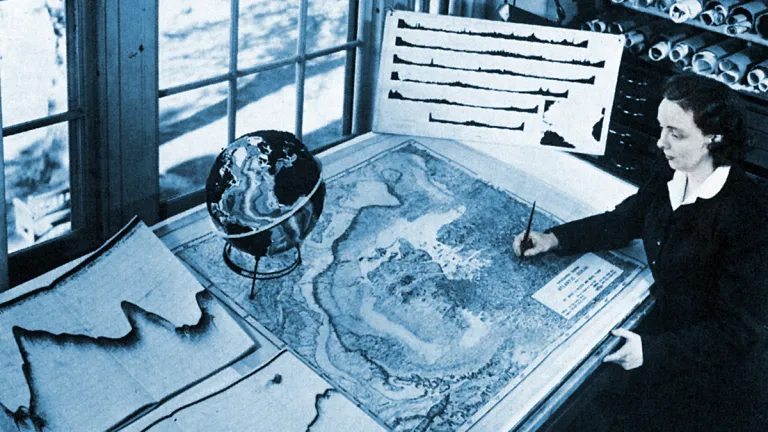
She has unrolled nearly a kilometer of paper stacked in the corner of her office — fathograms from soundings her boss and his graduate students have conducted on several Atlantic expeditions over the course of five years, expeditions not one of which she, any she, was permitted to join. She has spliced together a composite portrait of the ocean from the partial data sounded along the vessel’s various routes, recorded on blue linen paper with a crow quill pen and India ink. She has glued together strips of this blue linen paper into an enormous sheet sprawled across several drafting tables, magnified by a fortyfold scale of exaggeration to render the subtleties of the data legible; one of those subtleties would be the spark of revolution. On this enormous sheet, she has plotted the various depth measurements — the underwater peaks and troughs, the smooth slopes and the sudden plunges. She has marked each depth reading as a dot on the graph. A note on the staff. Dots spaced about an inch apart, to be connected into a melody of meaning.
And there in that void of data, in that inch of silence, is where the computational mind reaches its limit and the compositional mind begins, demanding a virtuosity of interpretation.
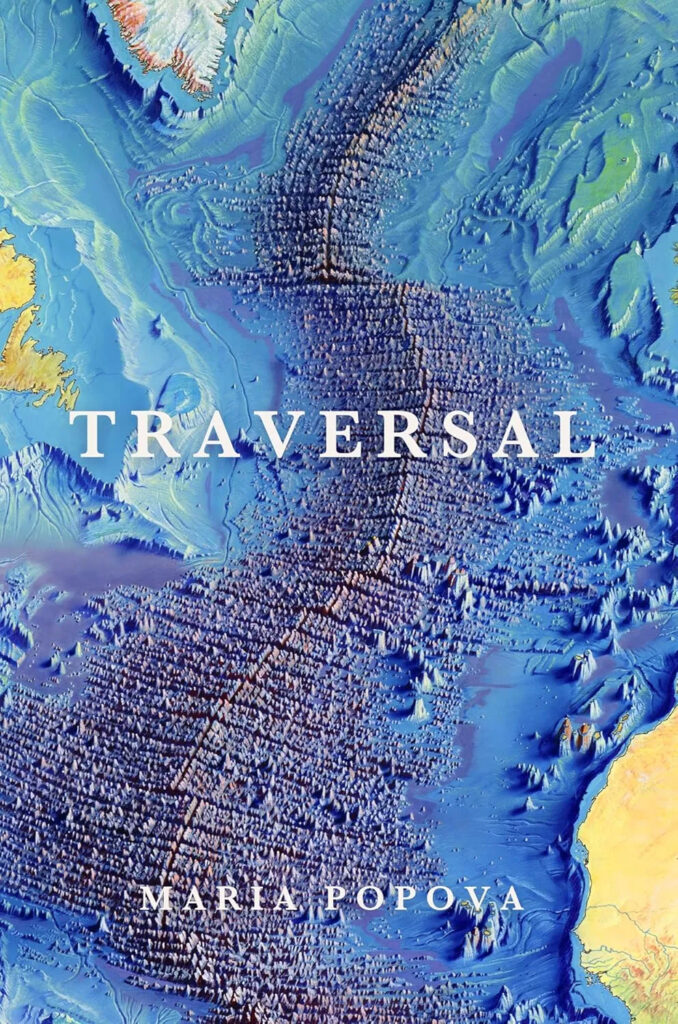
Not too many people can say this about their lives: The whole world was spread out before me (or at least, the 70 percent of it covered by oceans). I had a blank canvas to fill with extraordinary possibilities, a fascinating jigsaw puzzle to piece together: mapping the world’s vast hidden seafloor. It was a once-in-a-lifetime—a once-in-the-history-of-the-world—opportunity for anyone, but especially for a woman in the 1950s. The nature of the times, the state of the science, and events large and small, logical and illogical, combined to make it all happen.
Love Anyway
BY MARIA POPOVA
You know that the price of life is death, that the price of love is loss, and still you watch the golden afternoon light fall on a face you love, knowing that the light will soon fade, knowing that the loving face too will one day fade to indifference or bone, and you love anyway — because life is transient but possible, because love alone bridges the impossible and the eternal.
I think about this and a passage from Louise Erdrich’s 2005 novel The Painted Drum(public library) flits across the sky of my mind:
Life will break you. Nobody can protect you from that, and living alone won’t either, for solitude will also break you with its yearning. You have to love. You have to feel. It is the reason you are here on earth. You are here to risk your heart. You are here to be swallowed up. And when it happens that you are broken, or betrayed, or left, or hurt, or death brushes near, let yourself sit by an apple tree and listen to the apples falling all around you in heaps, wasting their sweetness. Tell yourself that you tasted as many as you could.
This, of course, is what life evolved to be — an aria of affirmation rising like luminous steam from the cold dark silence of an indifferent cosmos that will one day swallow all of it. Every living thing is its singer and its steward — something the poetic paleontologist Loren Eiseley captures with uncommon poignancy in his 1957 essay “The Judgment of the Birds,” found in his altogether magnificent posthumous collection The Star Thrower (public library).

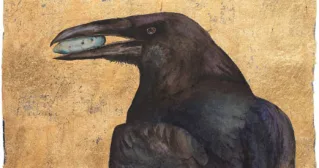
Raven by Jackie Morris from The Lost Words by Robert Macfarlane
Eiseley recounts resting beneath a tree after a day of trekking through fern and pine needles collecting fossils, dozing off in the warm sunlight, then being suddenly awakened by a great commotion to see “an enormous raven with a red and squirming nestling in his beak” perching on a crooked branch above. He writes:
sunday newsletter
For an act of resistance to the tyranny of algorithms, try the Marginalian newsletter—undistracted notes on the search for meaning, free, ad-free, AI-free, fully human since 2006. (Here is an example.)
The Marginalian participates in the Bookshop.org and Amazon.com affiliate programs, designed to provide a means for sites to earn commissions by linking to books. In more human terms, this means that whenever you buy a book from a link here, I receive a small percentage of its price, which goes straight back into my own colossal biblioexpenses. Privacy policy. (TLDR: You’re safe — there are no nefarious “third parties” lurking on my watch or shedding crumbs of the “cookies” the rest of the internet uses.)